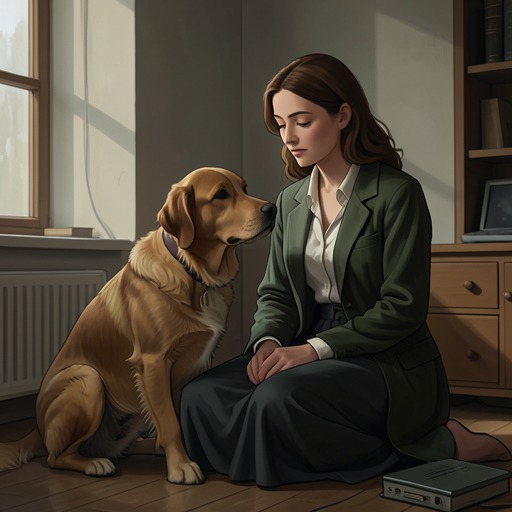
Denny Swift and Eve
The Art of Racing in the RainDenny Swift and Eve’s relationship is the emotional center of their family life: a swift, affectionate courtship becomes a marriage, then a partnership reshaped by Eve’s illness and Denny’s caregiving. Seen largely through Enzo’s observations, their bond is expressed not only in devotion but in changed routines, acts of care, and the painful distance illness can impose even between people who remain deeply attached.
Courtship and Marriage
During Enzo’s first year with Denny, the two formed a deep fondness and trust. Enzo therefore felt unsettled when Denny quickly fell in love with Eve and brought her home. Eve acknowledged Enzo’s place in Denny’s life and reassured him that she did not intend to come between them; Enzo, however, expected their relationship to change the closeness he had shared with Denny. His early resentment marks the beginning of a new household, not a lasting rejection of Eve.
Eve soon moved into Denny’s apartment, and the two married in a small ceremony on Whidbey Island. Eve’s immediate family and close friends attended; Denny had no siblings to invite, and his parents did not travel well. Eve’s parents’ beach cottage set the scene for the wedding, but even the celebration revealed the practical terms of Enzo’s place in the family: he had to stay away from the beach and bay and use a designated spot by the recycling containers. After the wedding, Eve moved through the apartment with greater confidence, rearranging towels, linens, and furniture. Her expanding authorship of the shared home made visible how thoroughly the couple’s lives had joined. Enzo’s resistance softened as he recognized Eve’s pregnancy.
Their domestic partnership had its own rhythms. Eve was an organizer who made lists and assigned household tasks; Denny completed them readily, and the work often brought affectionate attention between the two. Their intimacy thus appeared in ordinary exchanges as well as in the intensity of their early courtship. The same domestic life that Enzo initially experienced as an intrusion became a family structure he would later try to preserve.
Racing, Illness, and Changing Responsibilities
Denny’s racing commitments could create tension. Eve had prepared herself for his absences, but an unplanned practice in Sonoma made her angry and afraid. Enzo, who understood her reaction through bodily cues he believed he could sense, registered the strain in the household. Their difference was not simply a disagreement about racing: his schedule affected the shared life on which she depended, while her fear and anger were difficult for Denny to read.
Eve’s health brought a more profound change. Her symptoms came unpredictably: crushing headaches, debilitating nausea, dizziness, or dark moods, with stretches of relief between episodes. Denny responded by cutting back his work hours, taking Zoë to preschool, reading with her, teaching her numbers and letters, and taking over grocery shopping, cooking, and cleaning. He did these tasks without complaint, trying to remove burdens that might add to Eve’s stress. The practical care was an expression of continuing love, but it also changed their intimacy: with so much responsibility to manage, Denny could no longer give Eve the same playful and physical attention Enzo had once observed.
As Eve’s suffering intensified, Denny sometimes took Zoë out so she would not hear her mother’s cries. He asked Enzo to stay with Eve, trusting him to provide the comfort he could not offer while caring for their daughter. Enzo curled up beside Eve, whether she was in bed or had collapsed on the floor, and she held him close while describing her pain. Denny’s delegation of this comforting role did not mean he had stopped loving Eve; it showed how care was being divided among the family as her illness consumed more of their lives.
Hospitalization and Intimacy Under Strain
Eve’s long hospital stay forced Denny to replace the family’s spontaneous routines with a strict schedule. Zoë ate breakfast at home, went to summer camp, and returned to a home where Denny prepared dinner; after the meal, he took her to visit Eve. He then bathed Zoë, read to her, and put her to bed before turning to bills and disputes with the health insurer. Weekends were largely spent at the hospital. Denny was balancing employment, parenting, household work, and visits, while Enzo accepted fewer walks and less attention as part of the same effort to keep the family going.
The strain was also visible in the way Eve managed being seen. During a visit with Denny, Zoë, and Eve’s parents, Eve appeared without her cap, revealing a shaved head and scars. She wore one of her own dresses instead of a hospital gown and tried to read to Zoë, but could not focus; Zoë read to her instead. Later, Eve asked Denny to leave even though she wanted Zoë and Enzo to stay. She explained that she did not want her husband to see her as she was: her changed appearance and condition made her feel ugly in front of him. Denny answered that he saw who she really was, but Eve’s distress showed that reassurance could not erase her own sense of exposure. Their attachment remained, yet illness had altered the conditions under which she could bear his gaze.
Family Separation and Lasting Consequences
At one point, Denny explained to Zoë that Eve would stay with her parents until she felt better. The plan introduced separation into the family’s daily life even as Denny and Eve remained joined by concern for their daughter. After Eve’s death, Zoë directly insisted that she wanted to live with Denny and Enzo rather than remain with her grandparents. Denny told her that lawyers and judges had to decide where she would live. The legal conflict that followed was not part of the couple’s marriage, but it exposed the stakes of the family they had formed together: Eve’s absence left Denny and Zoë’s shared home contested, and Zoë’s own wish became part of that struggle.
Eve’s illness and death also shaped Enzo’s response to loss. At a dog park on Mercer Island, his grief led him into a return to instinctive animal behavior, including killing and eating a squirrel; afterward, Denny found him and quietly took him back to the car. The episode makes the cost of Eve’s absence visible beyond Denny’s caregiving and Zoë’s disrupted home. Their relationship had organized a shared life whose loss reached every member of the household. Its defining pattern was sustained attachment under pressure: Denny continued to care for Eve as her illness narrowed their ordinary life, and the family remained bound by that care even after she was gone.